Finance & Fintech Events: The Complete Calendar
The Recipe: Emma Grant, Moody's
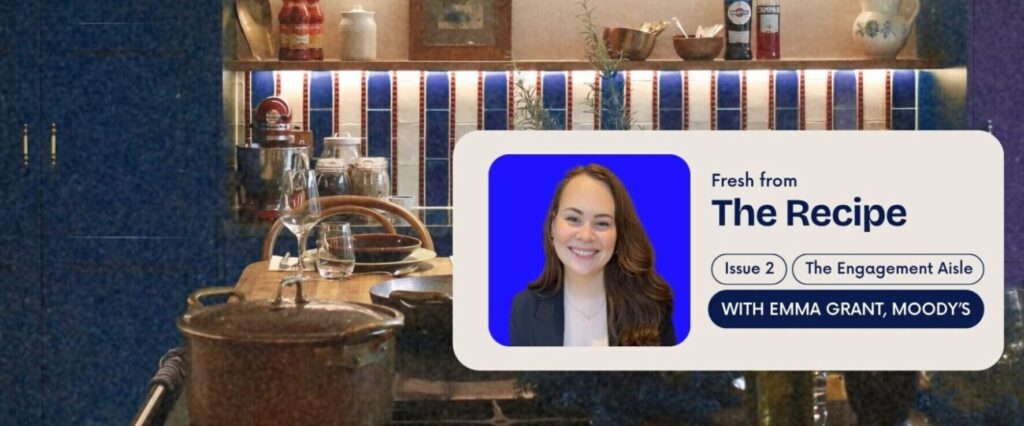
In this edition of The Recipe, an interview series where we ask events professionals to tell us the secret ingredients to their career success (and what they like to cook when they clock off), we speak to Emma Grant – Associate Director for Global Events at Moody’s.
Emma is an award-winning events professional with deep expertise in delivering high impact global programmes across the financial services sector. Emma leads a global event strategy for Moody’s Ratings, financial institutes and private credit with a focus on conferences, engagement and brand-led experiences that drive commercial and reputational outcomes.
Prep work: what goes on behind the scenes at your events?
“From a planning perspective, you want to start getting organised with a project plan. But really the first step should come before you start to put things on paper. For us, it’s that initial team kickoff where we ask what we want to achieve and, if we had no budget or time restraints, how we would do things.
We know we’ll have to rein things in but don’t let the budget, timeline, or team resources stop that initial creativity. Reach for the stars first then bring it in to where it needs to be for the project plan secondly. Starting with the ideas is a really important part so that creativity doesn’t take a back seat.
Everyone sees the end result – an amazing event with people happy and smiling – and that’s the part they will remember. What they don’t see is that the project probably kicked off ten months ago with the team having a brainstorm, creating a strategy, setting objectives, and negotiating contracts. All those parts of event planning are often forgotten about by the outside world.
The event strategy part is so key to what we do, specifically in corporate events. It’s important that every event is tied back to business objectives, team objectives, and department objectives, to ensure the event is successful beyond just looking good”.
How do you keep things from burning when pressure is on?
“Plan for every eventuality and expect the unexpected. You can’t control everything, so leave time to deal with every eventuality. Speaker slides coming in the night before a conference is not an issue if that’s the only thing you’re waiting for. It’s a huge issue if you still have 70% of your project undelivered”.
And keep things running smoothly?
“At one point in my career someone told me that event managers should be like swans. Under the water your feet are going 100 miles an hour but, above the water, you’re gracefully gliding across the show floor and no one knows anything’s wrong.
That’s super important because people look to you to lead and reassure them. If you are stressed, your speakers are stressed and not performing well, so then the tech team gets stressed. It all tumbles in a domino effect.
But if you are calm and have everything under control – even if you have to go and hide in a breakout room for 10 minutes and do some deep breathing – it helps keep everything on track.
It’s not always easy and I don’t think anyone does it 100% of the time, but it helps to try to remain calm and plan for everything you can”.
What’s your shopping list for a successful event?
“You can plan for everything but sometimes not knowing what’s going to happen down the road is a good thing. That little sprinkle of the unknown is what keeps us learning and keeps us pushing ourselves.
Creativity is definitely a key ingredient and it’s one that’s sometimes forgotten about because organisation and logistics have such a high focus. You need that creativity at the beginning to really enhance your event”.
On what aisle do we find engagement?
“Engagement for me comes in two parts. As a project lead one of my main jobs is to keep the project team and internal stakeholders engaged. It’s more than sending out project updates, it’s giving these people ownership of the experience that you’re creating and making them feel that it’s their experience as much as it is yours.
You might be a project lead, but you’re not the only person responsible for the event. Making sure the team is engaged, whether it’s people that are working on the project for months or those that are just there on the day to support with registration, means everyone feels like it’s their responsibility to make the event a success.
Externally we try and encourage engagement wherever we can by continuously asking ourselves what we can do in the space to enhance engagement and encourage questions. Throughout planning, we come up with ideas such as digital screens with live polls and post-event reports.
One thing we all share in the Moody’s team is that we want our customers to be as happy as possible and one way of doing that is if customers are able to leave the event with something they didn’t have when they walked in the room. It means making sure that our teams are there to answer questions, engage with delegates, and be fully part of that event“.
What are your ingredients for career success?
“Over the last few years, something I’ve learned to value more is work-life balance. I came to a realisation that burnout doesn’t lead to success. Actually the more relaxed you are, the better your event is going to be. Nobody needs a project manager who’s working 24 hours a day to make things happen to then crash on site. You need to look after your mental health and your physical health, and in turn that will allow you to be more successful in your career as well”.
What does success look like?
“To me, a successful event is happy delegates. I love standing in a conference room and seeing the networking room buzzing, people smiling, taking notes, and pictures; and hearing the anecdotal feedback of how much people are enjoying it.
– That’s also a success for the business, but there’s also measurement objectives an event has to meet. We have a Net Promoter Score (NPS) benchmark of 50 that we try to achieve for all of our events.
– We have post-event surveys but, rather than just focusing on a delegate at one event, it’s looking at this delegate’s feedback holistically across the 30 or so events they attended across the year to paint a bigger picture of what we’re doing for the business. The same delegates might attend the same events across regions, as we might offer the same conference in two different cities but with different speakers and from a different angle. It’s really interesting for us to see what their feedback is across the event portfolio and also across the globe.
– Something that is quite unique is that our events aren’t commercially driven and we don’t charge for entrance. Our ROI is based on brand awareness and how our thought leadership is delivered which allows us to put a huge focus on engagement and interactions. We put a lot of onus on the delegates and the stakeholders in networking breaks to make those conversations count, making them longer, running polling, Q&As, surveys, and trialling new apps and tools to deliver this value.
We all want our events to have a positive impact on the business. Recently, we’ve held some flagship events where we’ve moved to a wait list five weeks out because we have this legacy of excellent content, speakers, and networking opportunities at our events that we potentially didn’t have five or ten years ago.
The team has made a really conscious effort to up our game as the business ups theirs. So, while they’re delving into how to use AI within the business, we’re looking at the same in events. I don’t think events will ever be replaced by AI, but we’re thinking about how to use that tool to improve content, marketing, and data.
I want my team to feel the impact of the work I do, just as I feel the impact of the work they do. It means asking how we can support and train each other, ensuring we have the capabilities to tackle challenges such as those new technological advancements”.